
About
I am a Full Professor and Ph.D. supervisor at Nankai University, where I am a member of the university's 100 Young Academic Leaders program. I serve as Deputy Director of the Tianjin Key Laboratory of Network and Data Security Technology, and Director of NKSSecLab. I am also a core member of the research group led by Prof. Zheli Liu.
I received the 2026 ACM SIGSOFT Early Career Researcher Award, becoming the first recipient based at a university in Asia. The award recognizes one or two researchers worldwide each year. I have also been included in Stanford's list of the world's top 2% of scientists, selected for the Chinese Institute of Electronics' Young Elite Scientists Sponsorship Program (2025) and the National Outstanding Cyberspace Talent program in cybersecurity (2024), and received the ACM Tianjin Rising Star Award (2022).
Prior to joining Nankai University, I was a tenured Associate Professor and Research Professor at Tianjin University, China (2021–2024). Before that, I was a Research Assistant Professor at Nanyang Technological University, Singapore, where I worked with Prof. Yang Liu.
My research is in software security, with a focus on software supply chain security, AI4Security, and Security4AI. I study the security of multi-source, heterogeneous components as software evolves, spanning traditional software and LLM-based agent software. I have published over 100 papers in leading cybersecurity and software engineering venues, including IEEE S&P, CCS, ICSE, and FSE, with more than 70 papers in CCF-A journals and conferences. My work has received seven Distinguished Paper Awards at ICSE (×4), ASE (×2), and FSE (×1).
Research
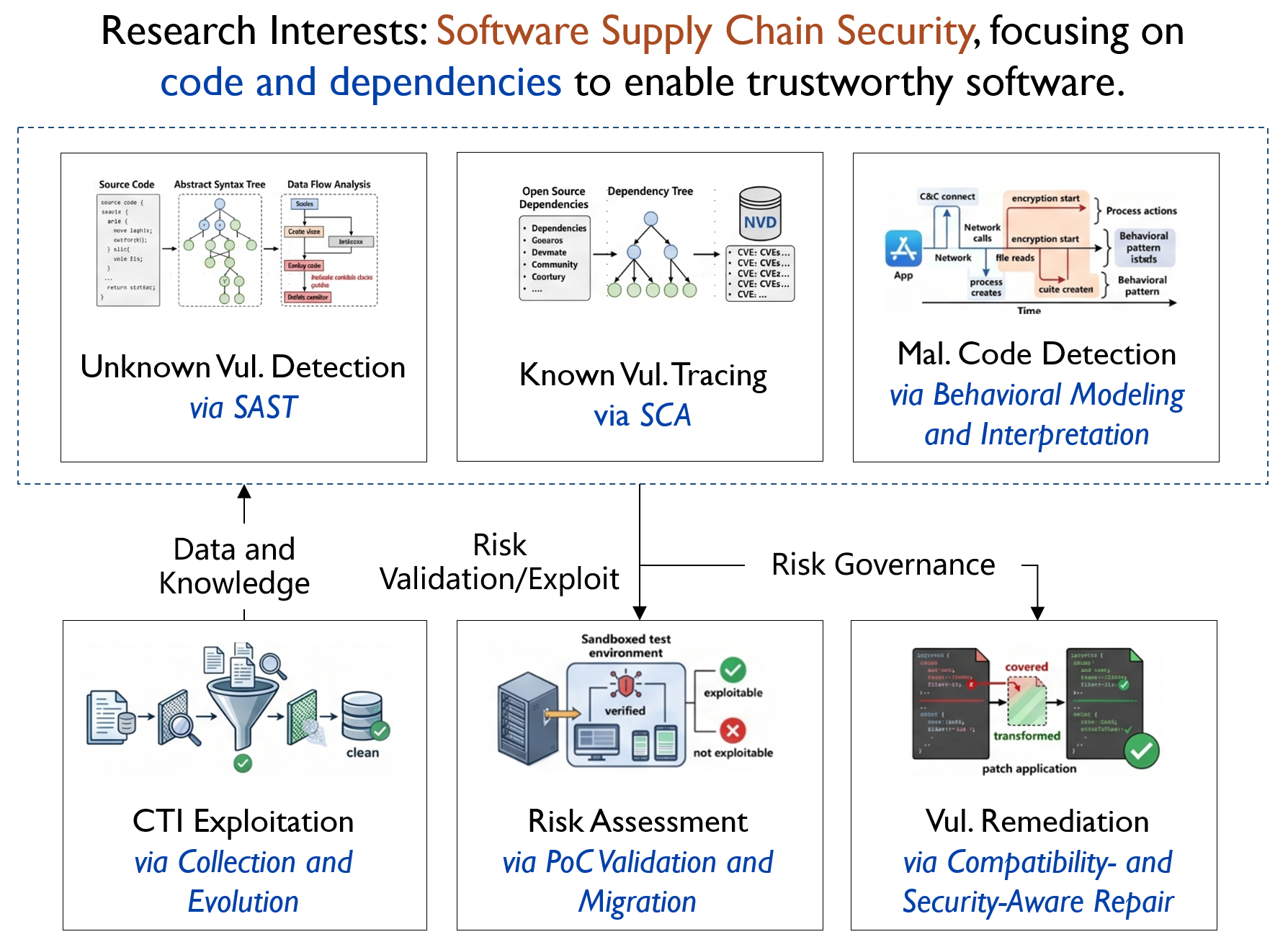
Securing software supply chains through component analysis, vulnerability discovery, and behavior understanding.
First-party component security
Program analysis, Static Application Security Testing (SAST), and vulnerability detection.
Third-party component security
Software Composition Analysis (SCA), dependency vulnerability propagation, and compatible remediation.
Malicious component analysis
Malware detection, behavior understanding, and explanation.
Exploring LLM-assisted vulnerability PoC generation and security validation. Related preprint →
Research overview
Selected Publications
-
Synchronizing Key Aspects: Enhancing Vulnerability PoC Reports from Multiple Sources
-
Towards Understanding and Characterizing Vulnerabilities in Intelligent Connected Vehicles through Real-World Exploits
-
ForeDroid: Scenario-Aware Analysis for Android Malware Detection and Explanation
-
Beyond Decision: Android Malware Description Generation through Profiling Malicious Behavior Trajectory
-
Static Application Security Testing (SAST) Tools for Smart Contracts: How Far Are We?
-
Automatically Distilling Storyboard with Rich Features for Android Apps
-
EndWatch: A Practical Method for Detecting Non-Termination in Real-World Software
-
Compatible Remediation on Vulnerabilities from Third-Party Libraries for Java Projects
-
Demystifying the Vulnerability Propagation and Its Evolution via Dependency Trees in the NPM Ecosystem
-
Accessible or Not? An Empirical Investigation of Android App Accessibility
-
Why an Android App is Classified as Malware? Towards Malware Classification Interpretation
-
A Performance-Sensitive Malware Detection System Using Deep Learning on Mobile Devices
-
GUI-Squatting Attack: Automated Generation of Android Phishing Apps
-
An Empirical Assessment of Security Risks of Global Android Banking Apps
News
Prospective students & collaboration
For questions about study and research opportunities in software supply chain security, program analysis, or malware analysis, please get in touch by email. Availability and arrangements can be discussed directly.
For student inquiries, include a CV, research interests, and relevant project or paper links. For collaboration, outline the research question, existing work, and proposed collaboration.
Awards
- ACM SIGSOFT Early Career Researcher Award, 2026
- Distinguished Paper Award (ICSE 2026)
- Stanford World’s Top 2% Scientists, 2025
- CAIE Young Talent Promotion Program, 2025
- National Cybersecurity Outstanding Talent, 2024
- Distinguished Paper Award (FSE 2024)
- Distinguished Paper Award (ASE 2023)
- Distinguished Paper Award (ICSE 2023)
- Rising Star Award (ACM China Council Tianjin Chapter), 2022
- Distinguished Paper Award (ASE 2022)
- Distinguished Paper Award (ICSE 2021)
- Distinguished Paper Award (ICSE 2018)
Service
- Associate Editor, Frontiers of Computer Science (FCS), May 2026–May 2029
- Young Editorial Board Member, Digital Communications and Networks (DCN), June 2026–June 2029
- 2027 Program Committee: USENIX Security, CCS, ICSE
- 2026 Program Committee: USENIX Security
- 2025 Program Committee: USENIX Security, IEEE S&P, CCS, ISSTA, OOPSLA
- 2024 Program Committee: USENIX Security, IEEE S&P, CCS, ISSTA, OOPSLA
- 2023 Program Committee: FSE, ASE
- 2022 Program Committee: ASE